


Denial is the tenth and final stage of genocide, according to Gregory Stanton’s “Ten Stages of Genocide” model.
It doesn’t only happen after the killing ends; it also happens during and afterwards, and can include the destruction or concealment of evidence.
Typical forms include denying or minimising deaths, disputing evidence, blaming victims, destroying records or bodies, intimidating witnesses, describing systematic crimes as isolated, and attacking those who document them.
As Nazi Germany’s defeat became increasingly clear and the Red Army approached Auschwitz in late 1944 and January 1945, the SS systematically attempted to destroy evidence of its mass murder: including gas chambers and crematoria, destroyed or burned records, removed equipment and attempted to eliminate physical traces of the crimes.
They also evacuated tens of thousands of prisoners westwards on brutal death marches, removing potential witnesses as the camp was abandoned.
Soviet forces arrived on 27 January 1945 before the SS could destroy the entire Auschwitz complex, leaving thousands of prisoners still alive and substantial physical and documentary evidence remaining.
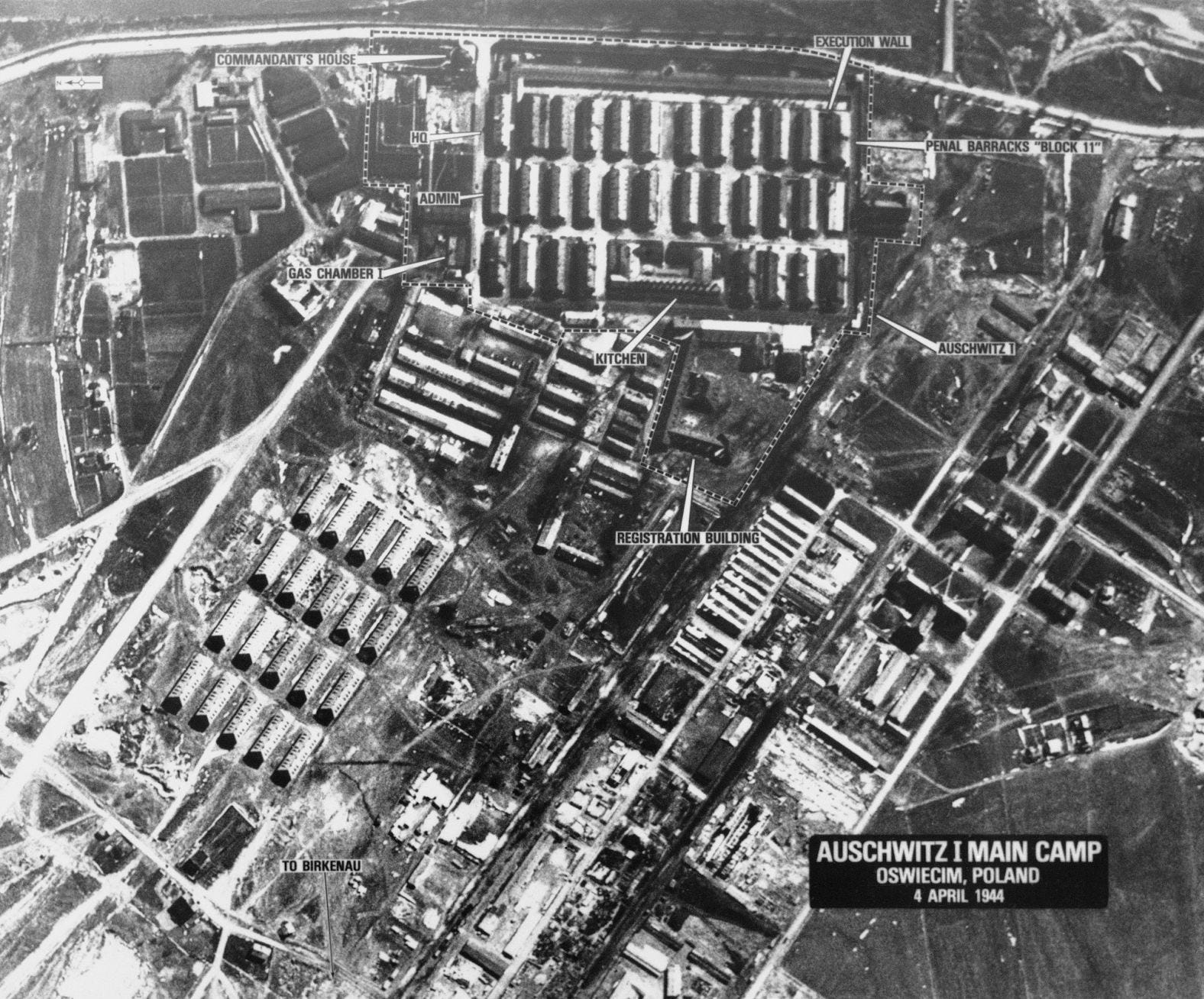
The Auschwitz-Birkenau Memorial was deliberately established as a place of remembrance, education and historical documentation.
The surviving ruins, buildings and archives provide material evidence of the crimes committed there, while the memorial serves to preserve the memory of the victims and counter denial and distortion of the Holocaust.
It was Israeli historian, associate professor of Holocaust and genocide studies at Stockton University, Raz Segal, who said early on that what is happening in Gaza is a “textbook case of genocide”.
In July 2025, more than 400 Holocaust and genocide scholars from over two dozen countries, organised through the Genocide and Holocaust Studies Crisis Network, issued a statement referring explicitly to “the genocide in Gaza” and arguing that Holocaust memory was being misused to justify genocidal violence.
Stephen Kapos, a Hungarian Jewish Holocaust survivor who lost much of his family, has repeatedly called what is happening in Gaza a genocide.
I remember Yoav Gallant announcing a “complete siege” of Gaza on 9 October 2023: no electricity, no food, no water, no fuel.
“We are fighting human animals,” he said, “and we are acting accordingly.”
The following day, addressing Israeli troops, he said: “I have released all the restraints.” And again he used the phrase “human animals” in describing 2.3M Palestinians, half of whom are children and babies.
After cutting off electricity, Israeli drones targeted the solar panels of hospitals and people’s homes (along with everything else). After cutting off water, they targeted desalination plants.
I remember Herzog declaring that “an entire nation” bore responsibility and rejecting what he called the rhetoric that civilians were unaware or uninvolved. Herzog subsequently maintained that his remarks had been taken out of context and that Israel did not target civilians.
I remember Netanyahu invoking Amalek as he addressed Israelis on 28 October 2023, a biblical reference that subsequently became part of the evidence cited in arguments concerning genocidal intent.
I remember Nissim Vaturi, the Likud politician and Deputy Speaker of the Knesset writing that Israel has a common goal of “erasing the Gaza Strip from the face of the Earth”.
I remember in December 2024, Israeli soldiers told Haaretz that a battalion commander in the Netzarim Corridor had instructed troops that anyone crossing a designated line was a terrorist: “There are no civilians. All of them are terrorists.”
I remember Netanyahu welcoming the removal of ICC Prosecutor Karim Khan, calling it a “very positive development” and Khan a “con job”, while saying that US Secretary of State Marco Rubio had assured him of Washington’s determination to act forcefully against the Court.

At the same time, the United States announced a campaign explicitly aimed at “dismantling” the ICC, an institution that had issued arrest warrants for Netanyahu and Gallant, following a concerted smear campaign, similar to that done to Julian Assange, which was then followed by Khan’s removal by the Assembly of States Parties on 24 July 2026.
As the prematurely correct Professor Norman Finkelstein recently said,
Israel has proceeded to do everything they said they would do from the start, with impunity, in front of the world’s eyes, live-streamed 24/7, for almost three years and counting.
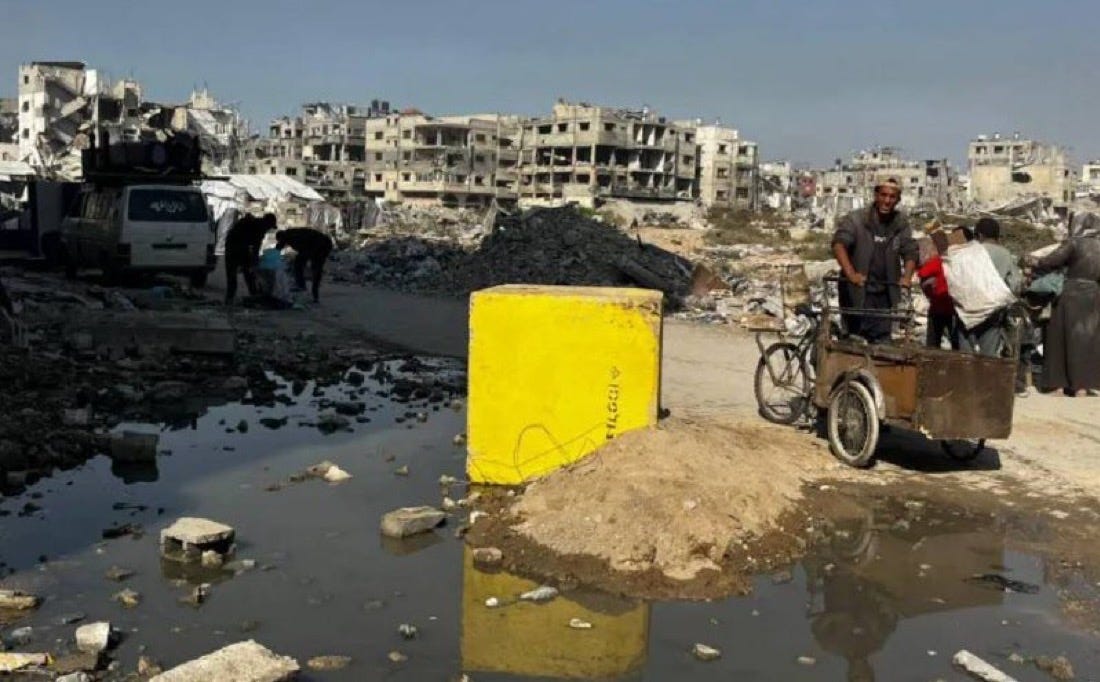
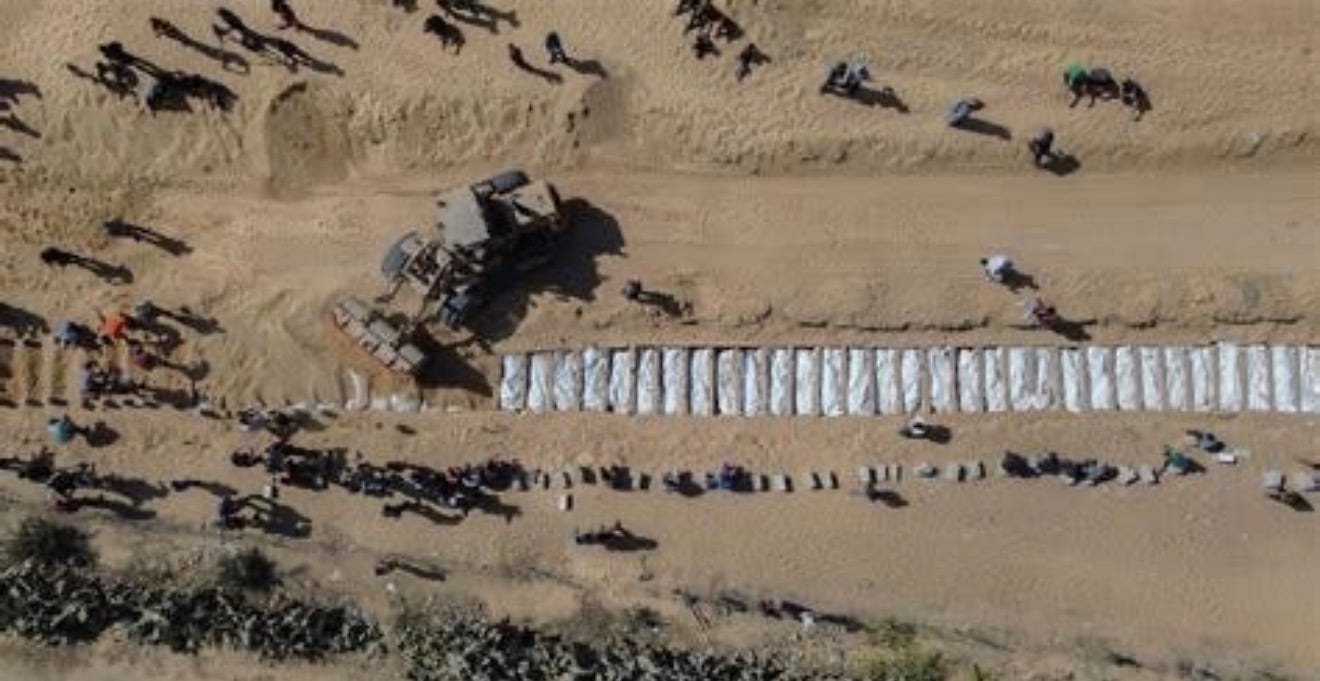
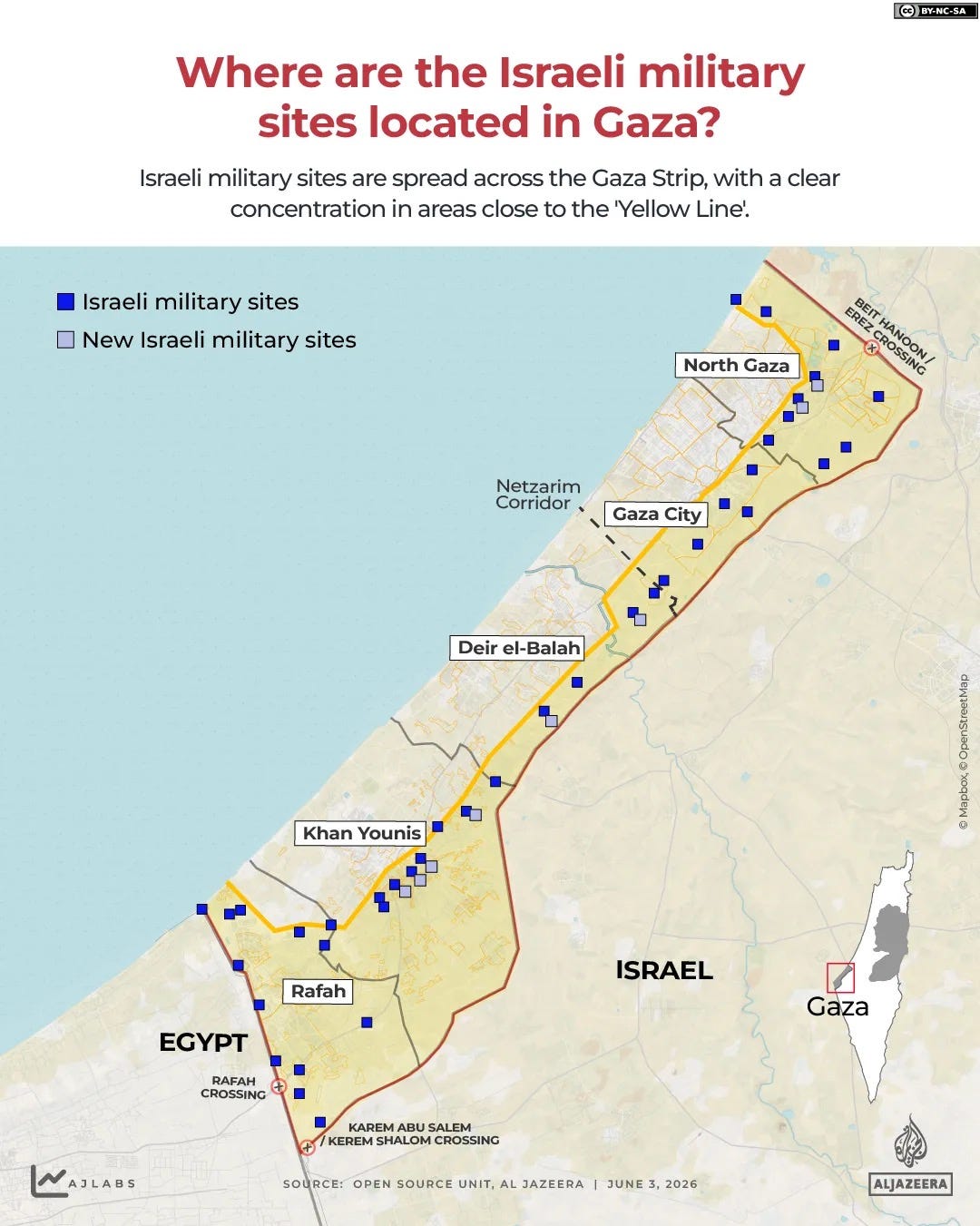
And right now, after advancing the “Yellow Line” over most of Gaza, Israel is reportedly tampering with the crime scene, and wiping evidence of a genocide in Gaza.
As Francesca Albanese said:
“Israel is taking the rubble away from Gaza so that evidence will never be properly collected … This is so criminal.”
On August 13, 2026, Al Jazeera reported that Israel is carrying out a massive, organised operation to crush, mix and transport millions of tonnes of rubble out of the Gaza Strip, in 100 trucks per day, according to human rights groups and monitors.
Gaza’s rubble is not just debris, it contains the human remains of thousands of Palestinians.
In a report entitled Gaza Rapid Damage and Needs Assessment Euromed reports that the removal of rubble may be an attempt at demographic engineering and erasing evidence of the genocide.
The report estimates that there are approximately 68 million tonnes of rubble across the Gaza Strip. At least 10 million tonnes of rubble have already been removed, crushed or moved from their original sites within areas under Israel’s unlawful military control, which encompass about two-thirds of the enclave.
About 400 heavy pieces of excavation, crushing and transport machinery are also working to demolish the remaining structures in Gaza. Debris is being loaded onto nearly 100 Israeli trucks daily, which are leaving the Gaza Strip for undisclosed sites within Israel and the occupied West Bank.
Budour Hassan, a researcher at Amnesty International, told Al Jazeera that this could be a calculated attempt to destroy evidence of crimes committed by Israel during the war.
“The bulldozing is an integral part of all attempts to destroy the lands in Gaza City and in the Gaza Strip in general,” Hassan said.
“The real fears are that these operations are taking place with the aim of obliterating and hiding evidence.”
Preventing access to evidence of crimes is a direct challenge to the International Court of Justice, Hassan said. The ICJ is currently overseeing a genocide case against Israel brought by South Africa and supported by numerous other nations.
“The occupation systematically works to obliterate evidence and destroy the features of the crime,” she added.
Mohammed Salha, director of the NGO Network in the Gaza Strip, believes the debris being moved out of the enclave contains missile fragments, ammunition, and personal belongings – crucial for future accountability.
“The occupation is moving the rubble, fragmenting it, and moving it into the Green Lineto obliterate the evidence and facts,” Salha told Al Jazeera.
“Naturally, there are thousands of martyrs under this rubble, and moving this rubble with their remains means a deliberate destruction of the crime scene that contains the basic evidence that exposes the occupation’s commission of war crimes, crimes against humanity, and genocide.”
The removal of ruins also means that the bodies of missing people, estimated by Gaza’s civil defence in July 2026 to number about 8,500, could be gone forever.
Using heavy machinery without prior forensic surveys risks crushing or scattering these remains, severely infringing on the rights of families to know the fate of their relatives.
Abu Asim, a Palestinian citizen whose family members remain buried in the eastern areas of the Gaza Strip, now designated as behind a military “Yellow Line“, shared his agony with Al Jazeera.
“My family’s story is that their body parts were scattered in the streets, and some of them are still to this day under the rubble of the house, and their remains have not been brought out,” he said.
“We lost them, and the first tragedy was their martyrdom, and the second and daily tragedy is the absence of these graves and the absence of the evidence with which we will try this occupation for these crimes and atrocities.” (Source: Al Jazeera)
The UN independently confirms that Gaza’s rubble requires clearance with particular attention to human remains and unexploded ordnance, while the ICRC has warned about people disappearing because remains are left beneath rubble and has stressed the need for forensic resources to identify the dead.
The pattern is unmistakable. There is now substantial expert and institutional support for the conclusion that Israel’s conduct in Gaza constitutes genocide.
Under international humanitarian law and the law governing missing persons and the dead, human remains, burial locations and potentially evidentiary material demand identification, dignified treatment and preservation. Removing rubble containing unidentified bodies without adequate forensic documentation therefore raises an issue not merely of historical memory but of the rights of families to know the fate of missing relatives and of future criminal accountability.
Never forget.
News story after news story, report after report, have been published identifying all the atrocities committed by Israelis. Individuals around the world cry out for justice for the Palestinians and yet, almost three years later, no one with power has done anything to bring an end to the madness. Is anyone in any of the world’s governments actually paying attention?
What impresses about Qureshi's writing is not just her humanism and her relentless care for justice, but a great capacity for analysis and even more for a synthesis. It is she and people like her that offer a glimpse pf hope in this dark and painful moment. I have no words to express my appreciation for what she does, time after time after.